Mapping a Path for Rural Democratic Campaigns
Nish Barot built a tool for rural Democratic campaigns in Pennsylvania. It just crossed its first state line.
A year ago, Nish Barot was a recent Penn State grad working as an engineer. Then he got laid off. He came back to Centre County, in the rural middle of Pennsylvania, and did something unexpected: he walked into his local Democratic office and asked how he could help.
He started writing postcards. Then he began driving around the district with his congressional candidate and campaign manager. And he started listening. Over the summer Nish had roughly 30 conversations across Pennsylvania, Maine, and Kansas, with campaign managers, candidates, county chairs, a state party regional director, and people who study progressive campaign technologies for a living. What he heard was frustration. Campaign data doesn’t live in one place. Instead it lives on paper sign-in sheets, in Google Drive, in text threads, and in tools that cost thousands of dollars a year. Getting data out of VAN, the standard tool most campaigns are stuck with, is "everyone's blocker." Older volunteers struggle with it. And nobody, anywhere, had their volunteer list in one place.
Nish had no political background. He had a degree in Human-Centered Design & Development, a builder's instinct, and a real problem in front of him. That combination became InvolveOS: a map-based volunteer and donor platform that helps rural Democratic campaigns see where their people are, where they aren't, and where to spend the little time and money they have.
InvolveOS starts by mapping volunteers. A campaign uploads its spreadsheet (however messy), the tool repairs the fields it can, flags the ones it can't, catches duplicate records, and plots everyone by county and town. And instead of just showing that a precinct is shifting politically, it shows precincts that are shifting where the campaign has nobody on the ground. A very useful thing to know when you're deciding where to send the three people you have on a Saturday.
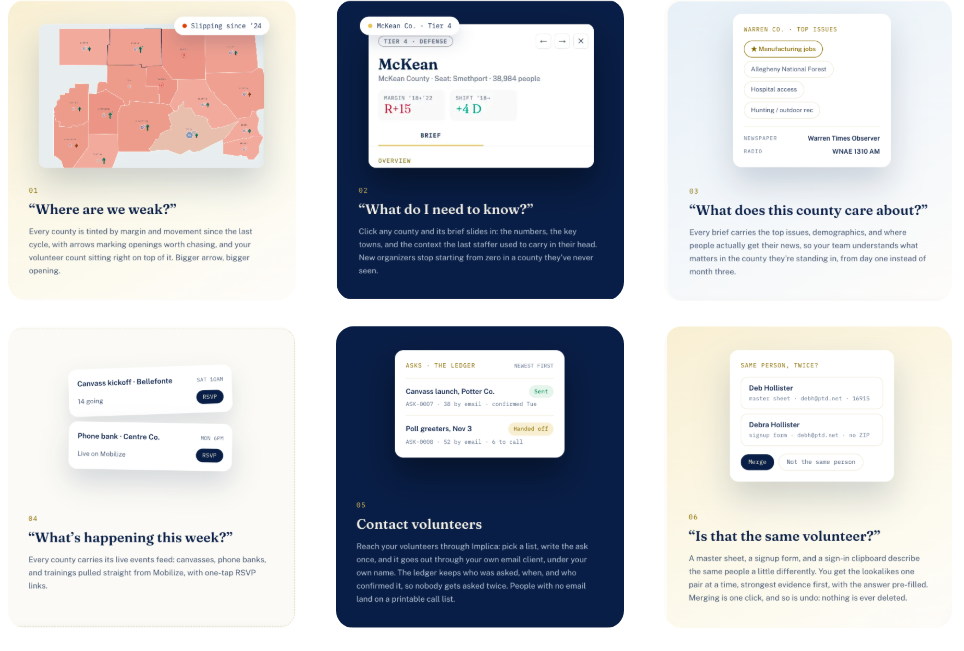
InvolveOS features, as described on the product landing page, answer every question a campaign field director might ask, from “Where are we weak?” when looking at a map to “Is that the same volunteer?” when looking at a new sign-up.
Many of the features Nish decided to build into InvolveOS came directly from watching campaigns work. For example, rural volunteer recruitment still runs largely on paper: a clipboard at a meet-and-greet, a sign-in sheet at a county dinner. Using InvolveOS, a staffer can photograph that sheet on their phone, which the app reads and lets them check every name before it lands in the roster. And because the person taking the picture is the same person uploading it, usually on the go, the web application works natively on a phone.
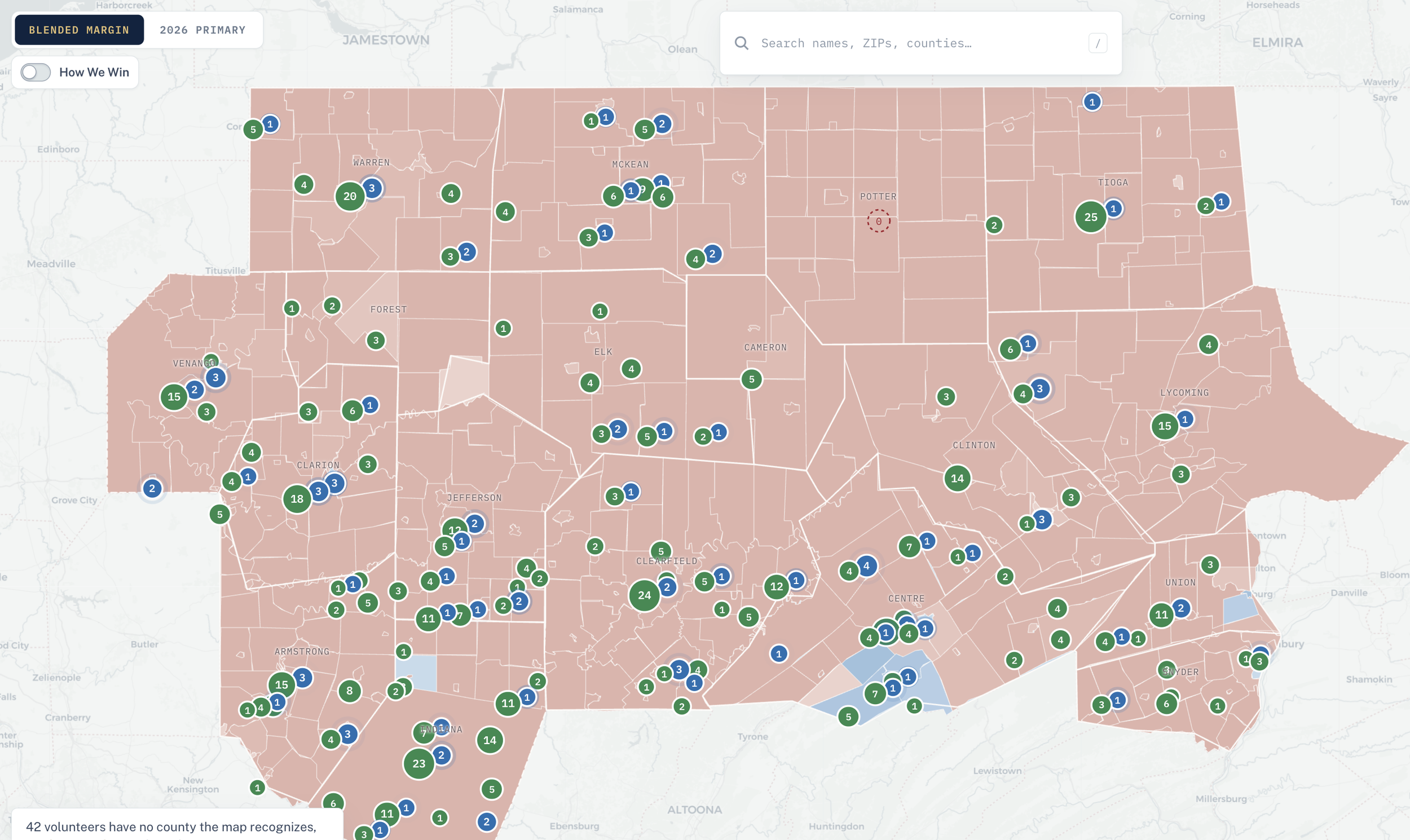
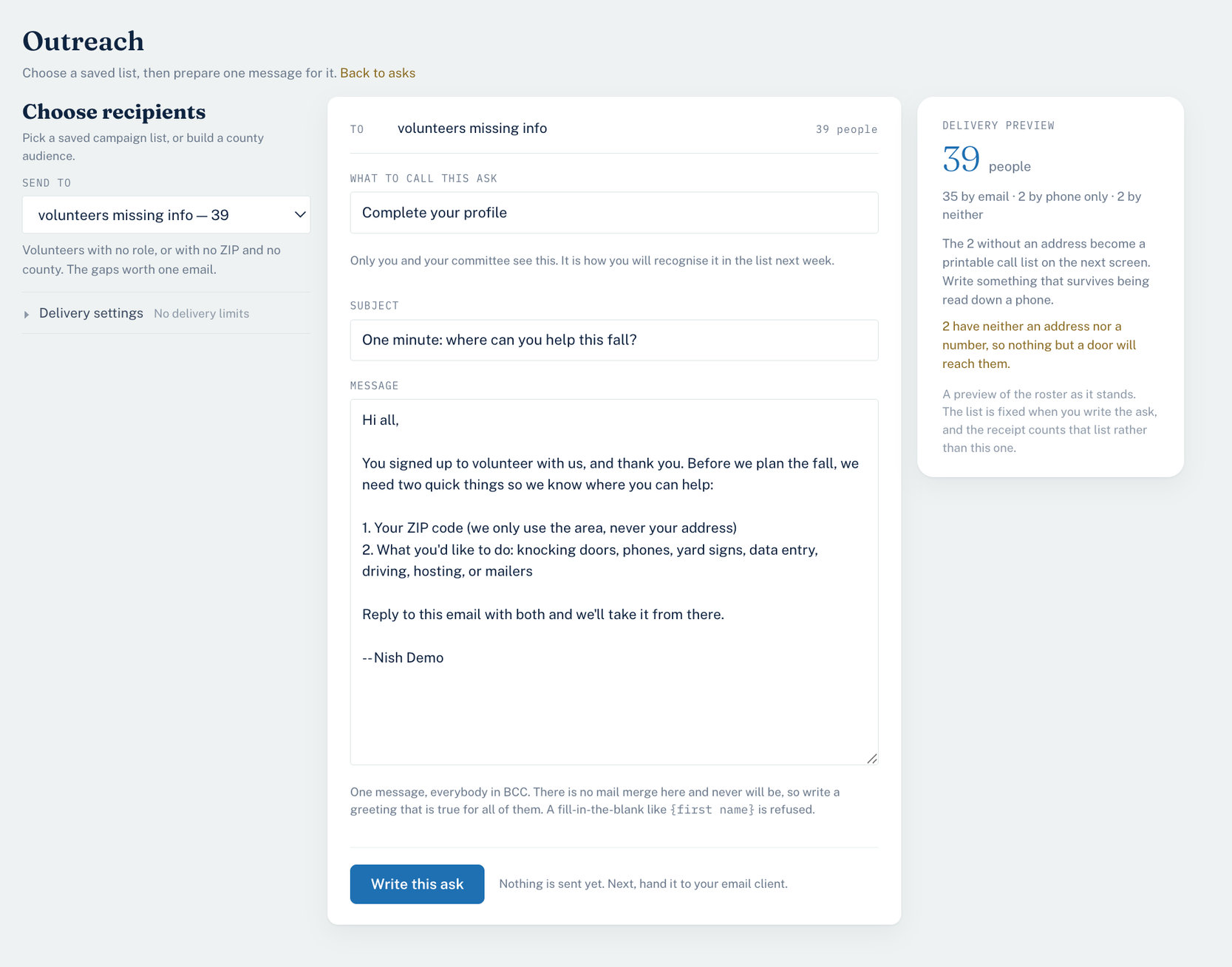
InvolveOS screenshots showing mapping (above) and volunteer outreach (right) tools.
InvolveOS is now live with five organizations: two congressional campaigns, a state house campaign, and a county party in Pennsylvania, plus, as of last week, a statewide campaign in Kansas. Between them, the platform holds more than 3,700 volunteer records across 31 Pennsylvania counties, and the first volunteer asks have gone out through the tool. The first paying campaign, Bilger for Congress in PA-15, is also where Nish started as a postcard writer. He's recently been introduced to the state party's executive director and is in early conversations with Higher Ground Labs about what it would take to build InvolveOS for rural campaigns beyond Pennsylvania.
Learning by asking
What's notable about Nish's summer isn't just that he built a product. It's how he found the problem in the first place. He walked into a local Democratic office with no political background and asked how he could help. Then he kept asking: What's not working? What takes too much time? What do you wish you had?
When Nish asked a rural state house candidate how she recruits volunteers, her answer was four words: "I just asked people." In some ways, that's also how Nish built InvolveOS. He walked into a space he knew little about, found the people doing the work, asked where they were getting stuck, and started building solutions. The transferable skill isn't knowing the answer before you arrive. It's being able to get up to speed in an unfamiliar space, figure out what problems are worth solving, and quickly make yourself useful.
Nish is looking to connect with former campaign managers and candidates from rural counties, and with anyone who has worked with a state party on down-ballot support. If that's you, reach him at me@nishbarot.com.
