A Public Portfolio, One Project at a Time
When Joe Manning joined Hack Your Summer, he was working more than 50 hours a week at a landscaping job. Hack Your Summer happened in the hours around that, the early mornings, the evenings, the gaps. He participated on his own schedule, looking for a chance to build something real and have something to show for it. Luckily, he didn't have to go far to find a problem to solve.
Joe’s parents, Chris and Bob Manning, are career educators with decades of classroom experience between them. Together they run The Passport Club, an elementary school geography and global cultures program. They sell products to teachers and schools, run their own operations, and, like a lot of small businesses, spend a disproportionate amount of time on things that aren't the actual work: accounting, invoicing, administrative workflow. Joe knew they had real problems. What he didn't know yet was exactly what they were or what to build to address them.
So Joe did something that turned out to be the most important part of the whole summer: he sat down and listened. He used Fireflies to record interviews with his parents, let the transcripts surface what was actually taking up their time, and built from there. As he put it afterward: "What I didn't expect this summer was how much learning AI would force me to understand how their business functioned along with their goals for the future." The biggest thing he learned wasn't technical. It was how much you get from interviewing and listening before you touch a tool.
What he built is a collection of small tools and projects that are genuinely useful to his parents right now. The first was an interactive classroom deck for teachers, a geography guessing game with clues, landmarks, and a reveal mechanic, built to solve a specific problem: The Passport Club's products are hard for teachers to fit into days already packed with math and reading. A ready-to-run morning meeting slide removes that friction. It's not a complex build, but it's one his parents would have spent a lot of time making on their own.
The second was a QuickBooks cleanup and workflow automation project, still in progress, that tracks their products by category and automates the path from purchase to invoice to shipping receipt. Accounting had been eating up time it shouldn't. The third was a live dashboard Joe built in Claude Cowork to track all of his own progress, interviews, milestones, and builds, connected to the transcripts so he could always trace what he'd done and why.
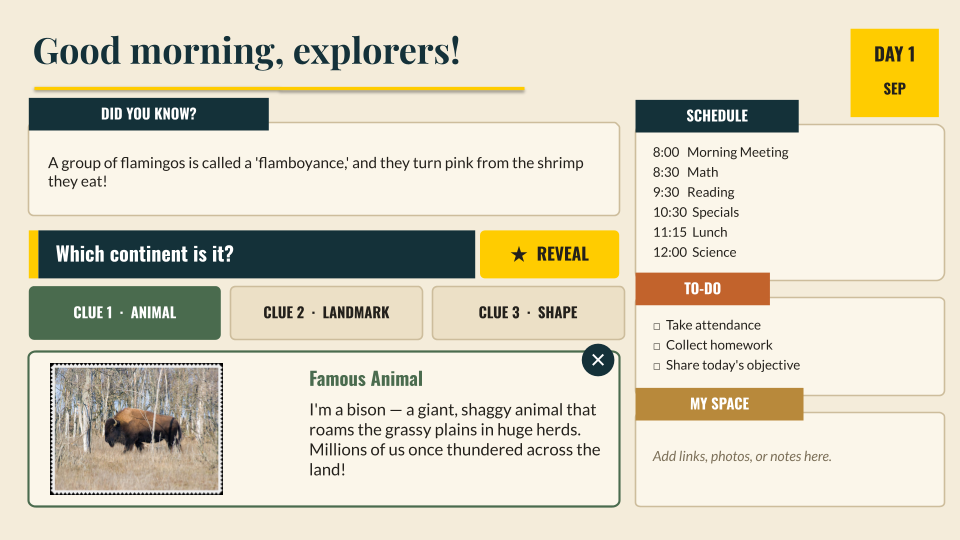
Joe’s interactive classroom deck for teachers, illustrating the geography guessing game. In this example, students are given clues about an animal and asked in which continent it lives.
Four weeks earlier, Joe described himself as someone who knew ChatGPT and not much else. By the end of the session he was building workflow automations with Claude Code and Claude Cowork, using AI to move faster on things that would have taken his parents hours, and doing it in whatever time he could carve out around a physically demanding full-time job. These projects gave Joe a chance to learn by solving problems for people he knew, rather than working through another tutorial or building something just for the sake of having a demo.
Joe also wanted to capture what he was learning. He started building a public portfolio that brought his projects, experiments, and learning together in one place. The idea wasn't simply to have a nicer-looking resume. He wanted someone visiting the site to be able to see what he'd actually built, understand why he'd built it, and follow how his thinking and skills were developing over the course of the summer.
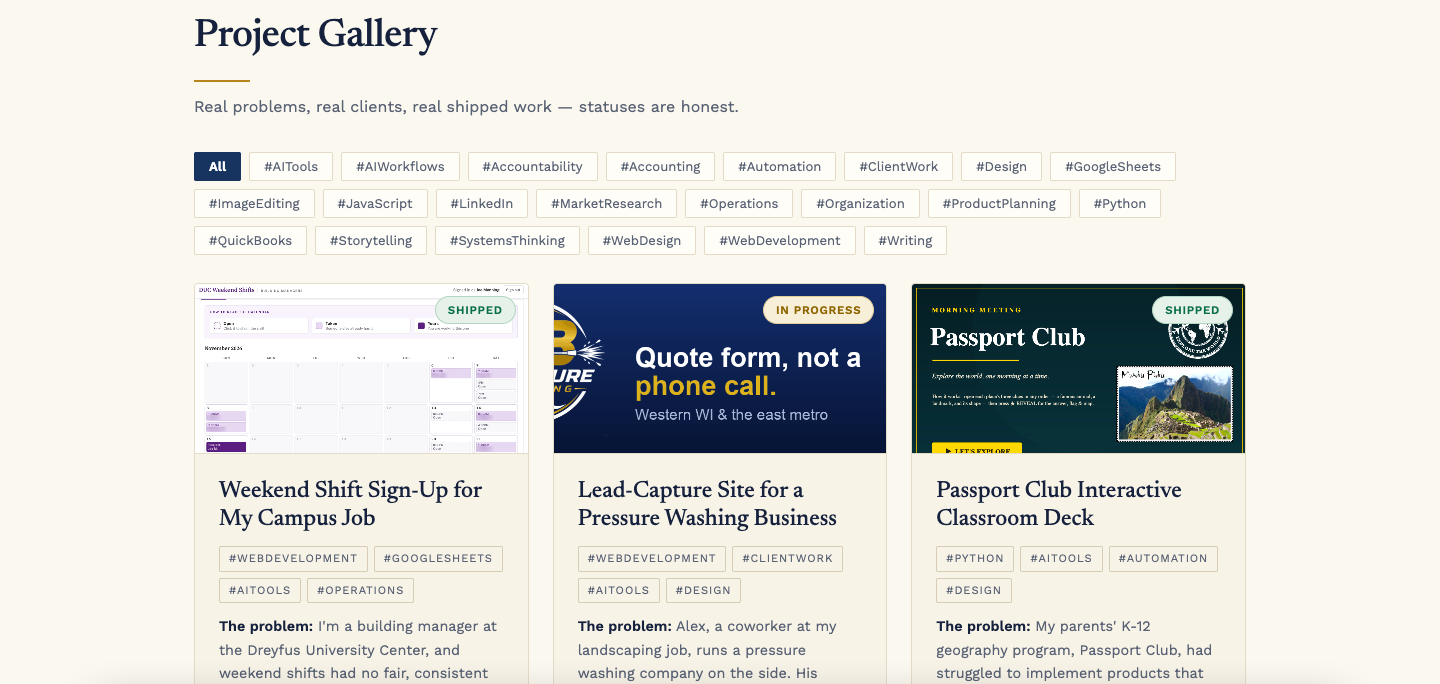
Project Gallery section of Joe’s personal website. Built using Netlify, Joe has made it incredibly easy for visitors to learn about his past work, the kinds of tools he’s familiar with, and the results he’s delivered.
The site has a ton of detail. Joe documents his projects and their current status, keeps a learning log of the tools and ideas he's been exploring, and includes enough context to make the work understandable to someone who wasn't there when it happened. Some projects are finished and shipped, some are still in progress, and the portfolio makes that visible too. It's less a collection of polished accomplishments than a record of someone learning by doing.
Whether it's a personal website, a GitHub profile, a lab or research page, a blog, or something else entirely, creating public-facing artifacts like Joe's portfolio is a fantastic way to communicate what you're capable of doing. You don't have to wait for someone to give you a credential or a job title before you can start building evidence of your skills. The work itself can be the evidence.
The Passport Club's K-12 geography and global cultures program is at passportclubonline.com. Joe’s personal website, with his project gallery, lives here https://cosmic-muffin-41f2b5.netlify.app/#projects
