Sorting It Out: Solving a Recycling Problem from Two Angles
Andrea and Abhay never formally teamed up during Hack Your Summer. They worked on separate projects, in separate tracks, with separate goals. But they were both trying to solve the same underlying problem: recycling sorting is broken, and technology should be able to fix it. So they stayed in conversation throughout the program, sharing resources, comparing notes, and exploring the problem from complementary perspectives, each going deep on the parts that matched their own skills and interests.
Andrea: Teaching a Model to See Recycling
Andrea, who recently completed her Master of Science in Analytics at Georgia Tech, came in knowing she wanted to work with computer vision in an industrial setting but not yet sure how. Through conversations with Abhay, she found something she wanted to solve. The problem was specific and real: Materials Recovery Facilities (MRFs, the places that actually process the single-stream recycling you put in your bin) have to sort incoming material fast and accurately, and contamination between material types is a serious, expensive problem. She spent the first couple of weeks researching object detection models before landing on YOLO11, a fast, real-time detection architecture developed by Ultralytics well suited to high throughput conditions.
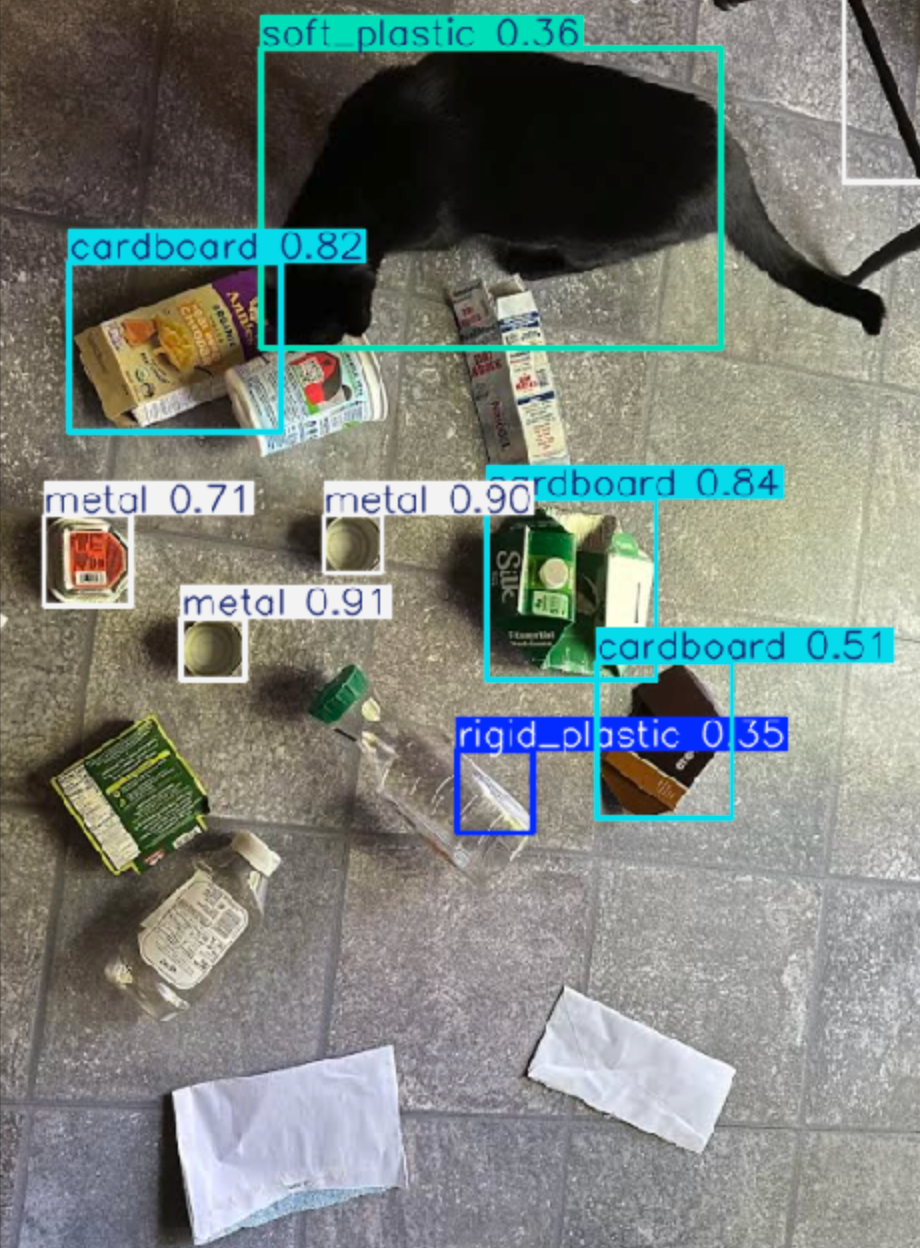
Andrea couldn't visit a MRF but she still got to know her datasets by interrogating her own recycling bin. Here her cat is helping investigate and has been classified by Andrea’s first model as “soft plastic”. (It has since been confirmed that cat is soft but not plastic.) This classification error makes sense when you look at the dataset used to fine tune the model.
Finding the right dataset took just as much effort. Ultimately she chose the ZeroWaste dataset from Boston University, built specifically to capture the extreme clutter and highly deformable objects found in real MRF environments, and augmented it with items from the TACO dataset (Trash Annotations in Context, an open image dataset of litter taken under diverse environments) to address class imbalance. She converted the ZeroWaste dataset into YOLO format with four classes (rigid plastic, cardboard, metal, and soft plastic), and fine-tuned her own YOLO11 model on it.
Then she ran it! Fifty epochs, on her own computer, over six hours of training time. The results were promising enough to make the next problem clear: she needed to speed up hyperparameter optimization, and started researching Optuna, an open-source framework for automating that search, as the next step.
By the end of the session, Andrea was also sitting with a bigger question: what does it actually mean to learn when AI is doing the coding for you? A HYS mentor offered a response that stuck with her: you're still bringing your own knowledge and curiosity, and that's what lets you push back on the AI and ask better questions. She finished the session wanting to slow down enough to understand what her YOLO model was actually doing, not just whether or not it worked. Andrea plans to use this as an opportunity to learn how to build with AI while deepening her own skills and knowledge.
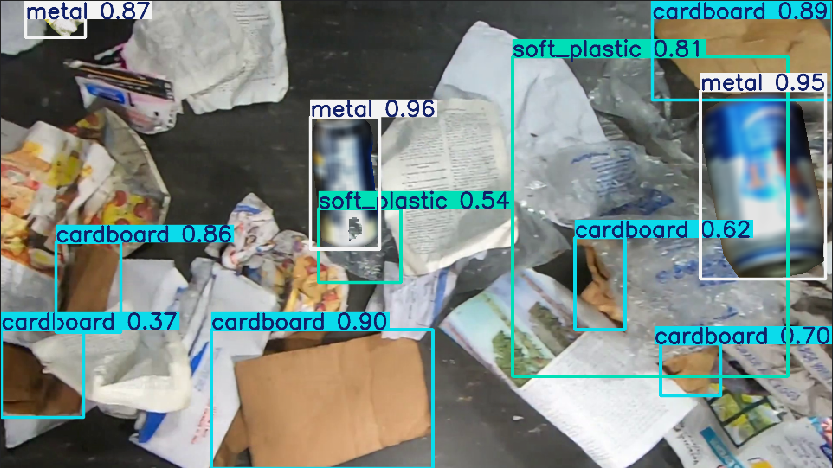
Sample image from ZeroWaste dataset, labeled by fine-tuned YOLO11 model.
Abhay: Building the Machine That Does the Sorting
Where Andrea was training a model to identify materials, Abhay was building a physical system to act on that identification. A mechanical engineering sophomore at Cal Poly San Luis Obispo specializing in mechanical design and hardware, he came in without a settled idea, so he began reflecting on problems within his own community. After experiencing the challenges of his university’s inefficient recycling system firsthand, Abhay developed the idea for AutoSort and quickly committed to bringing it to life.
His scope narrowing was deliberate and engineering-minded: instead of sorting all recyclables, he focused exclusively on aluminum and glass, the two material types with the highest recovery value in real recycling economics. The device uses sensors to identify incoming material, with an Arduino Uno translating that sensor feedback into precise movements from servo motors that physically separates it accordingly. Abhay’s comfort zone was the hardware: the circuit schematics, the mechanical design, building the physical sorting mechanism. The biggest stretch came from integrating sensors and building the machine learning model to classify incoming materials. He trained the model offline in Python on his computer before deploying it as a compact on-device classifier that could make sorting decisions in real time, the same underlying challenge Andrea was working through from the software side.
AutoSort in action. An Arduino Uno translates sensor readings into precise movements from the servo motors, allowing the prototype to identify incoming material and physically sort it in real time.
By the final weeks he had a working prototype, sensor and sorter together, distinguishing aluminum and glass from other materials in real time. The video of an apple core and a piece of aluminum foil moving through the device and getting correctly separated shows that AutoSort was a big step in the right direction toward solving the problem.
In building AutoSort, Abhay learned that the engineering process is rarely linear. Sometimes progress meant making the system work; other times, it meant finding ten new ways it could fail.
Collaboration: Another Kind of Teamwork
What makes this pair of projects notable isn't just that two people worked on similar problems. It's that they recognized the overlap early and kept learning from one another throughout the program. They stayed in conversation throughout, sharing datasets, comparing approaches, and helping each other think through decisions neither had to make alone.
They weren't a team. But taken together, their work illustrates another kind of teamwork: independent builders making each other's work better simply by building alongside one another. That's exactly the kind of connection Hack Your Summer hopes to create.
Andrea Wackerle's computer vision for recycling sorting project and Abhay Sivaraman's AutoSort prototype were developed during Hack Your Summer Session A, 2026.